
Classification : Experimental Neurological Therapy
Development Status : Classified
Primary Researchers : Michael Toscani, Dr. Elena Rodriguez, Logan Fisher
Objective : Eliminate pathological fear while preserving normal survival instincts.
Fearless was developed from a simple but revolutionary premise: Fear is not the enemy. Pathological fear is.
Fear is essential to human survival. It allows us to recognize danger, make split-second decisions, and avoid situations that threaten our lives. Without it, humanity will not survive.
Pathological fear is different.
In disorders such as Post-Traumatic Stress Disorder (PTSD), specific phobias, panic disorders, and recurring trauma-related nightmares, the brain struggles to update emotional memories after the threat has passed and becomes trapped in a cycle where the emotional response outlives the danger itself. Long after a traumatic event has ended, ordinary sights, sounds, smells or memories may continue to trigger the same intense neurological alarm as though the event were happening again.
Fearless was designed to interrupt that cycle.
Rather than erasing memories or suppressing normal fear, the treatment was engineered to weaken the abnormal emotional response attached to traumatic memories while preserving the memories themselves.
Patients would remember what happened.
They simply would no longer be forced to relive it.
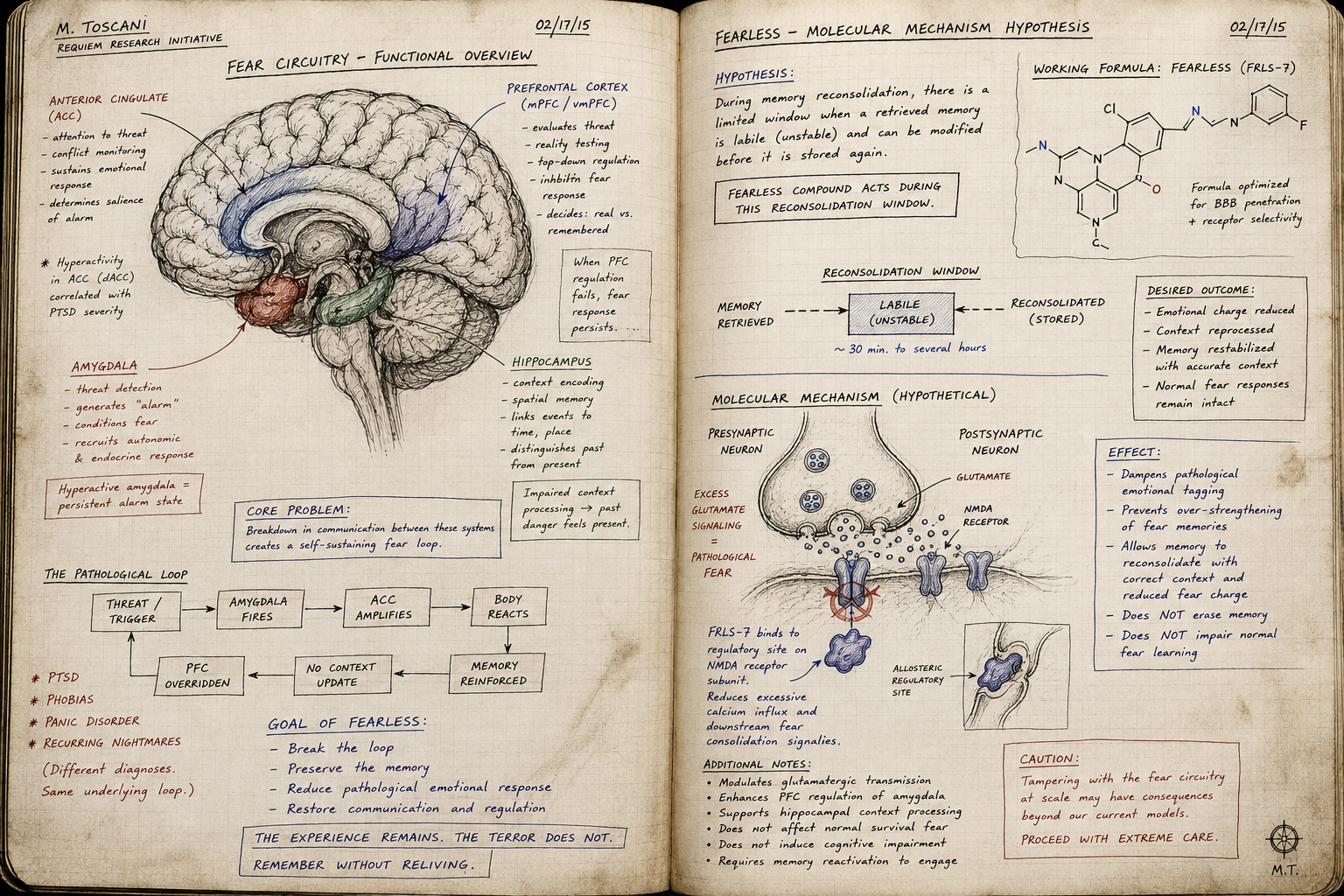
The Fearless Project is based on the interaction of several key regions of the human brain that together regulate fear, memory, and emotional control.
The amygdala serves as the brain’s primary threat detection center. It rapidly evaluates danger and initiates the body’s alarm response, increasing vigilance while activating the physiological changes associated with fear.
The hippocampus provides context to that alarm. It records where and when experiences occur, allowing the brain to distinguish between a present danger and a memory of one. In healthy individuals, this system helps recognize that a traumatic event belongs to the past. When that process becomes disrupted, reminders of the original event may trigger the same fear response as the event itself.
The anterior cingulate cortex helps determine how much attention the brain continues to give to a perceived threat, while the prefrontal cortex evaluates whether that threat is still real. Working together, these systems normally regulate emotional responses and prevent unnecessary fear from dominating conscious thought.
When communication between these regions becomes impaired, the brain may continue reacting as though danger still exists even though the individual consciously knows they are safe.
Fearless does not attempt to erase memories; instead, it targets the process known as memory reconsolidation.
Each time a memory is recalled, it briefly enters a biologically flexible state before being stored again. During this window, the emotional association attached to the memory can be modified before it is reconsolidated.
Fearless was engineered to selectively influence this process.
By reducing the excessive emotional significance assigned to traumatic memories while strengthening the brain’s ability to recognize that the danger belongs to the past, the treatment allows the memory to be stored again with dramatically reduced pathological fear.
The experience remains. The lesson remains. Only the involuntary terror begins to fade.
In theory, the patient retains the knowledge of what occurred without repeatedly experiencing the physiological and psychological response that originally accompanied it.
As Michael Toscani explained during the project’s earliest development:
“The amygdala generates the alarm, and the hippocampus gives that alarm context to tie it to a memory. The anterior cingulate keeps the emotional response alive, while the prefrontal cortex decides whether the threat is real or only remembered. When those systems stop communicating properly the brain reacts as though the danger still exists. PTSD, phobias, recurring nightmares, panic disorders… they’re different diagnoses, but they all share the same underlying problem. The fear response becomes trapped in a self-sustaining loop.”
When Logan Fisher realized the implications, he summarized the objective in a single sentence:
“So, you’re trying to break the loop.”
Michael’s answer would become the guiding philosophy behind the entire Fearless Project:
“Not by erasing memories. People should remember what happened to them, they just shouldn’t have to relive it every time the memory surfaces. If we can change how the brain reconsolidates those memories, the emotional response should fade while the experience itself remains.”
Fearless was never intended to eliminate fear. It was created to eliminate pathological fear.
No one anticipated the consequences of succeeding.