
Classification: Historical Manuscript
Author: Edmund Whitmore
Estimated Date: Late 17th Century
Current Location: Fearless Labs
The Whitmore Journal is a fragmented seventeenth-century manuscript attributed to Edmund Whitmore, the founder of Requiem Estate. Long believed to have been lost, the surviving pages were rediscovered among the archival collections of the Rhode Island Historical Society during Lorenza Toscani’s investigation into the history of Requiem Estate. Rather than existing as a single preserved volume, the journal had been scattered across multiple collections, incorrectly cataloged, filed under unrelated names, and separated from the historical records to which it belonged. Whether this fragmentation resulted from centuries of neglect or a deliberate effort to obscure Whitmore’s history remains unknown.
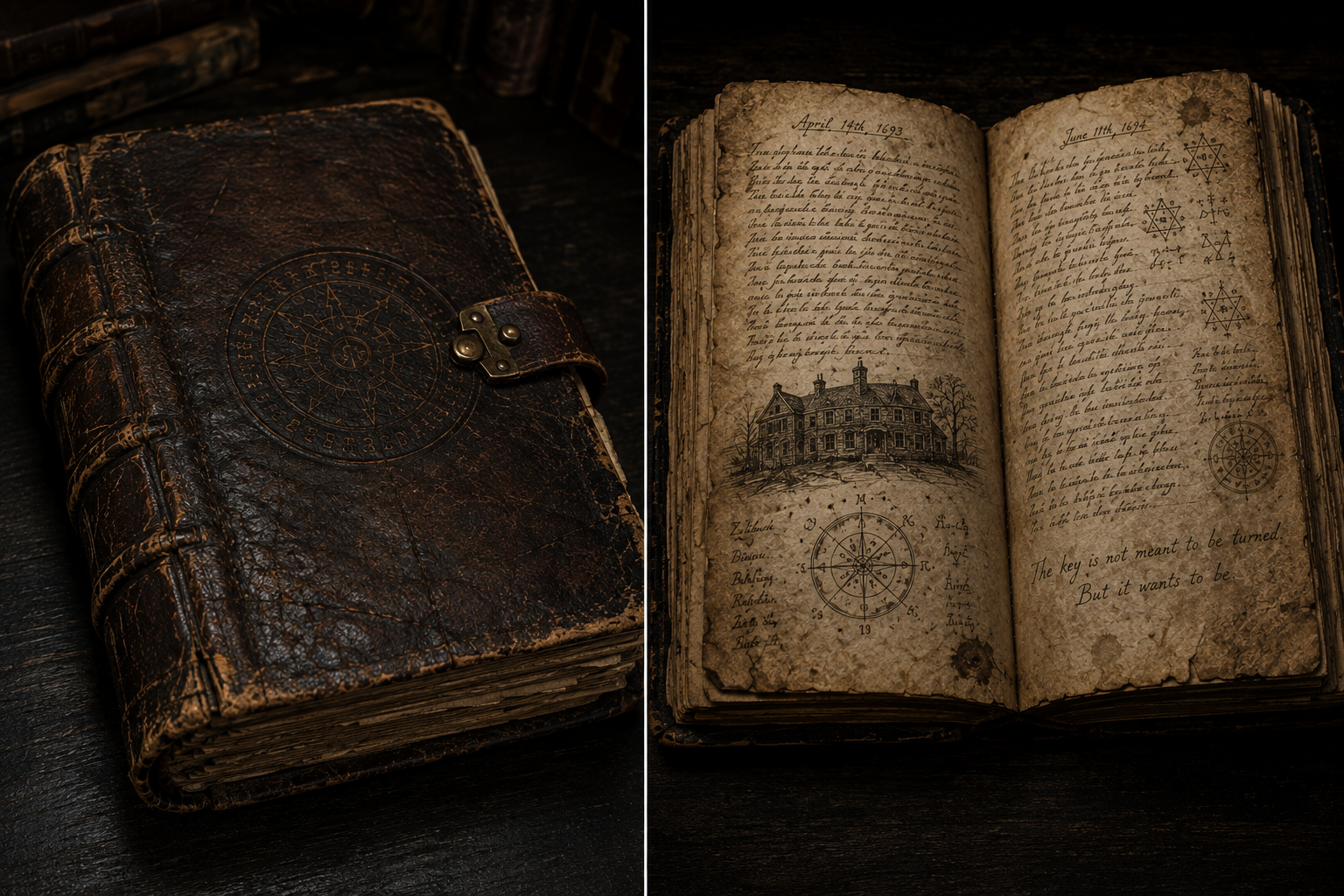
The surviving journal is bound in dark brown leather, its cover deeply cracked from age and centuries of handling. No title appears on the exterior, only the faint impression of an embossed circular seal worn nearly smooth with time. The spine is frayed, the corners rounded, and the leather bears scars from moisture, smoke, and repeated use. Inside, dozens of uneven handmade rag-paper pages are filled with remarkably precise handwriting recorded in faded iron-gall ink. Candle wax stains, water damage, and soot mark many of the surviving pages, while others have been cleanly removed, leaving only narrow stubs where they were once sewn into the binding. Several entries contain carefully drawn geometric symbols, architectural sketches, and repeated illustrations of an ornate brass key, suggesting these images held particular significance to Whitmore.
The journal’s discovery formed part of a much larger historical pattern. Colonial land deeds, construction records, town ledgers, and personal documents connected to Edmund Whitmore had likewise been dispersed, mislabeled, or preserved only as incomplete copies. Entire years appeared to be absent from the historical record. The gaps were too systematic to be dismissed as coincidence, suggesting that someone had intentionally broken Whitmore’s history apart long before modern investigators began searching for it.
The surviving entries reveal a man whose disciplined mind remained evident even as the events surrounding him became increasingly difficult to explain. Early passages describe the practical challenges of establishing a colonial settlement, surveying land, and overseeing construction of Requiem Estate. Later entries gradually shift in tone, documenting recurring dreams, unexplained discoveries, and a growing conviction that unseen forces were influencing both his thoughts and the land itself. Although Whitmore never claims to understand what he was experiencing, the journal reflects the steady unraveling of a man attempting to impose reason upon events that defied it.
During her examination of the recovered pages, Lorenza Toscani observed that Whitmore’s handwriting remained unusually controlled from beginning to end, as though maintaining order on the page had become an act of resistance against whatever was unfolding around him. The final surviving entry consists of a single sentence.
“The key is not meant to be turned. But it wants to be.”
No subsequent entries have ever been recovered.
Whether additional pages once existed, were deliberately removed, or remain hidden elsewhere is unknown.