
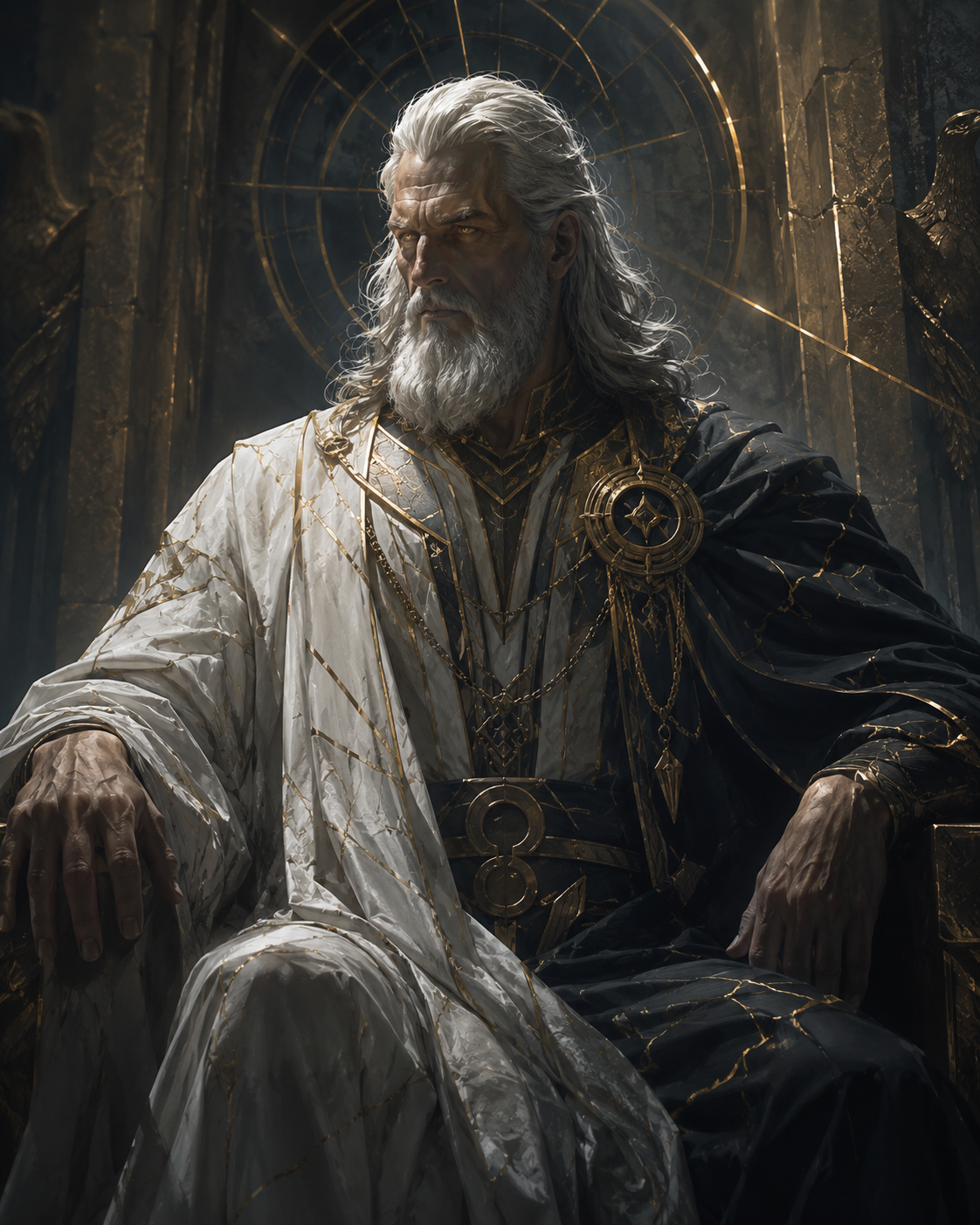
Classification: King of the Olympian Gods
Status: Active
Known Allegiance: Olympian Pantheon
To humanity, Zeus has always been remembered as the ruler of Olympus, the wielder of thunder, and the supreme authority among the Greek gods. Ancient mythology portrays him as a king who rewarded loyalty, punished arrogance, and exercised absolute dominion over the heavens. While those legends preserve elements of the truth, they reveal only a fraction of his true purpose.
Zeus is far more than the sovereign of the Olympian pantheon. He serves as one of the principal guardians of balance itself, charged not with ruling humanity, but with ensuring that neither gods nor mortals disturb the natural order upon which every realm depends. Unlike many immortals, Zeus does not govern through emotion or personal loyalty. His decisions are guided by a single, unwavering principle – every civilization must be free to determine its own destiny.
That philosophy has placed Zeus at the center of many of history’s greatest conflicts, none more significant than The Sundering, when the Greek, Norse, Egyptian, and Hindu pantheons united against the Axis of Ruin. Recognizing that no single civilization or pantheon could withstand the threat alone, Zeus forged an alliance unlike any before or since, leading the united gods in defense of both the waking world and the realm of dreams. Though victory ultimately came at tremendous cost, the alliance preserved the balance between worlds and ensured that humanity’s future remained its own.
Thousands of years later, Zeus faced a challenge unlike any battlefield could present. When Michael Toscani’s creation of Fearless began eliminating pathological fear throughout the world, Phobetor sought out Zeus in desperation, pleading that the treatment be stopped before it erased the very force that sustained his existence. Zeus understood the consequences. He knew that Fearless threatened not only Phobetor, but an ancient balance that had endured since the Sundering.
Even so, Zeus refused to intervene. To prevent humanity from pursuing its own future—even to save one of the oldest and most loyal gods—would have violated the very principle Zeus had sworn to uphold. His answer to Phobetor was neither cruel nor indifferent. It was the same truth every immortal must eventually face as humanity evolves beyond the world that created them.
“Adapt…or perish.”
Whether that decision preserved creation or unknowingly set humanity upon the path toward its greatest catastrophe remains a question history has yet to answer. To Zeus, however, the answer has never changed. The purpose of the gods is not to rule mankind or shield it from every consequence of its choices. Their purpose is to preserve the freedom that allows humanity to choose its own path, even when those choices reshape the destiny of gods themselves.